This manual guides users through operating and maximizing their experience with the Saraswati Chemistry Lab Manual, Class 11․ It simplifies setup and usage, offering clear instructions․
Purpose of a Chemistry Lab Manual
A chemistry lab manual serves as a crucial companion, guiding students through practical applications of theoretical concepts․ It’s designed to enhance understanding by providing detailed procedures for experiments, ensuring safe and effective lab work․ This manual simplifies the process of setting up and utilizing equipment, offering clear instructions and illustrations for optimal learning․
Furthermore, it mimics research lab procedures, fostering skills essential for future scientific endeavors․ The manual aids in recording observations, analyzing data, and ultimately, writing comprehensive lab reports – vital components of a robust chemistry education․
Safety Regulations in the Chemistry Lab
Prioritizing safety is paramount within the chemistry laboratory․ A comprehensive understanding and strict adherence to safety regulations are essential for preventing accidents and ensuring a secure learning environment․ This includes wearing appropriate personal protective equipment – goggles, gloves, and lab coats – at all times․
Proper handling and disposal of chemicals, awareness of potential hazards, and immediate reporting of any incidents are also crucial․ Following these guidelines protects both individuals and the lab environment, fostering responsible scientific practice․
Essential Laboratory Equipment
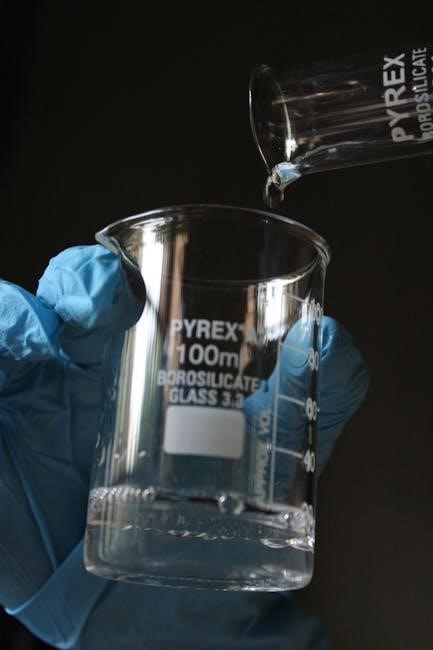
A well-equipped lab necessitates glassware, measuring tools, and heating/stirring devices for successful experimentation and accurate data collection, as detailed in manuals․
Glassware: Beakers, Flasks, and Test Tubes
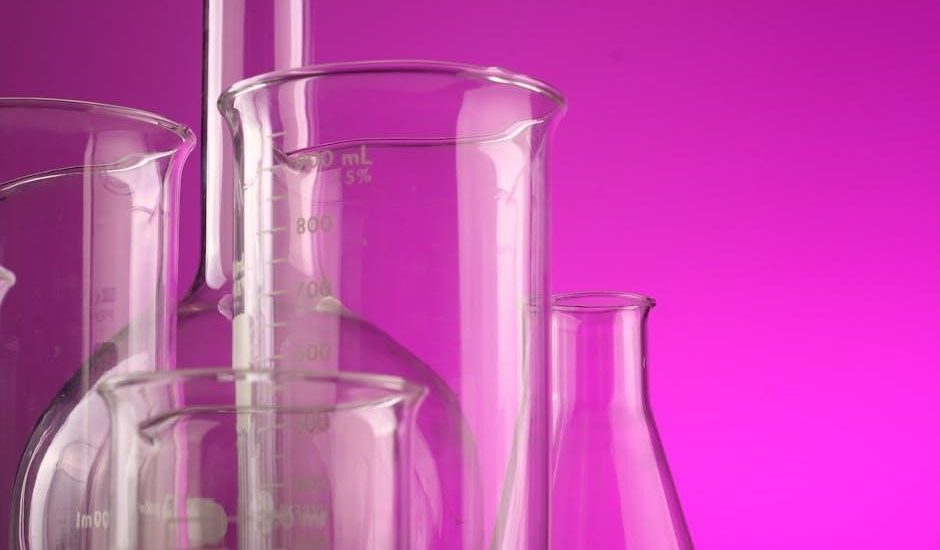
Essential glassware includes beakers for approximate volume measurements and mixing, flasks – Erlenmeyer and round-bottom – for containing and heating liquids, and test tubes for qualitative experiments․ These are fundamental tools detailed within chemistry lab manuals․ Beakers possess wide openings, facilitating easy stirring and observation, while flasks offer better containment during reactions․ Test tubes, often used for small-scale reactions, require careful handling due to their fragility․ Understanding the specific applications of each piece of glassware, as outlined in practical guides, is crucial for safe and accurate experimentation․ Proper cleaning and storage are also vital for maintaining their integrity and preventing contamination․
Measuring Tools: Graduated Cylinders and Pipettes
Accurate measurements rely on tools like graduated cylinders and pipettes․ Graduated cylinders provide reasonably precise volume measurements, suitable for transferring liquids, while pipettes deliver highly accurate, specific volumes․ Lab manuals emphasize proper reading techniques – observing the meniscus at eye level – to minimize error․ Pipettes come in various types, including volumetric and graduated, each suited for different applications․ Careful calibration and cleaning are essential for maintaining accuracy․ Mastering these tools, as detailed in practical guides, is fundamental to quantitative analysis and reliable experimental results․
Heating and Stirring Equipment
Essential for reactions, heating and stirring equipment includes hot plates, Bunsen burners, and magnetic stirrers․ Lab manuals detail safe operation – always wearing appropriate safety gear and understanding heat control․ Magnetic stirrers provide consistent mixing, crucial for homogenous reactions, while hot plates offer controlled heating․ Bunsen burners require careful adjustment of air intake for optimal flame temperature․ Proper technique prevents overheating and ensures even distribution of heat․ Understanding these tools, as outlined in practical guides, is vital for successful and safe experimentation․
Basic Laboratory Techniques
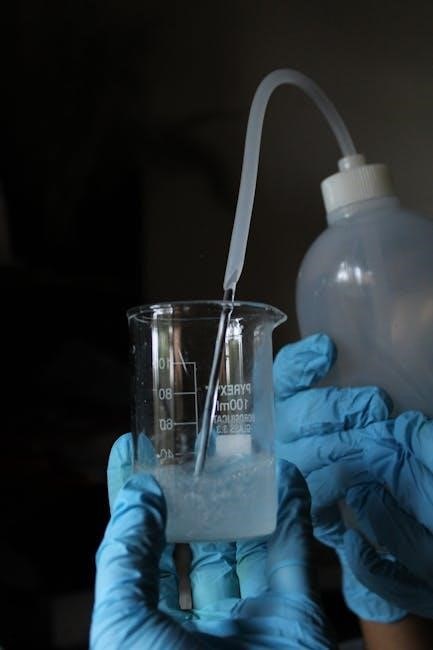
Lab manuals emphasize core skills like filtration, titration, and heating/evaporation․ Mastering these techniques, mimicking research lab procedures, is fundamental for accurate results and safe practice․
Filtration Techniques
Filtration is a crucial separation technique in chemistry, utilized to isolate solids from liquids or gases․ Lab manuals detail various methods, including gravity filtration – a simple process using filter paper and a funnel – and vacuum filtration, which accelerates the process using reduced pressure․
Understanding proper technique is vital; this includes selecting appropriate filter paper pore size based on particle size, ensuring a secure setup to prevent spills, and washing the residue effectively to maximize product recovery․ Careful attention to these details ensures clean separation and accurate experimental results․
Titration Procedures
Titration is a quantitative analytical technique used to determine the concentration of an unknown solution․ Lab manuals emphasize precise measurements and careful execution․ This involves slowly adding a solution of known concentration (the titrant) to the unknown solution until the reaction reaches completion, indicated by an endpoint․
Proper technique includes accurate preparation of solutions, careful reading of burettes, and appropriate endpoint detection using indicators or pH meters․ Understanding stoichiometry is crucial for calculating the unknown concentration from the titration data․
Heating and Evaporation Methods
Chemistry labs frequently employ heating and evaporation techniques for separation and purification․ Manuals detail safe practices using hot plates, Bunsen burners, and heating mantles․ Evaporation concentrates solutions by removing the solvent, often utilizing techniques like rotary evaporation for organic compounds․
Careful control of temperature is vital to prevent decomposition or unwanted reactions․ Distillation, a related method, separates liquids based on boiling points․ Proper ventilation and personal protective equipment are essential during these procedures․
Inorganic Chemistry Experiments
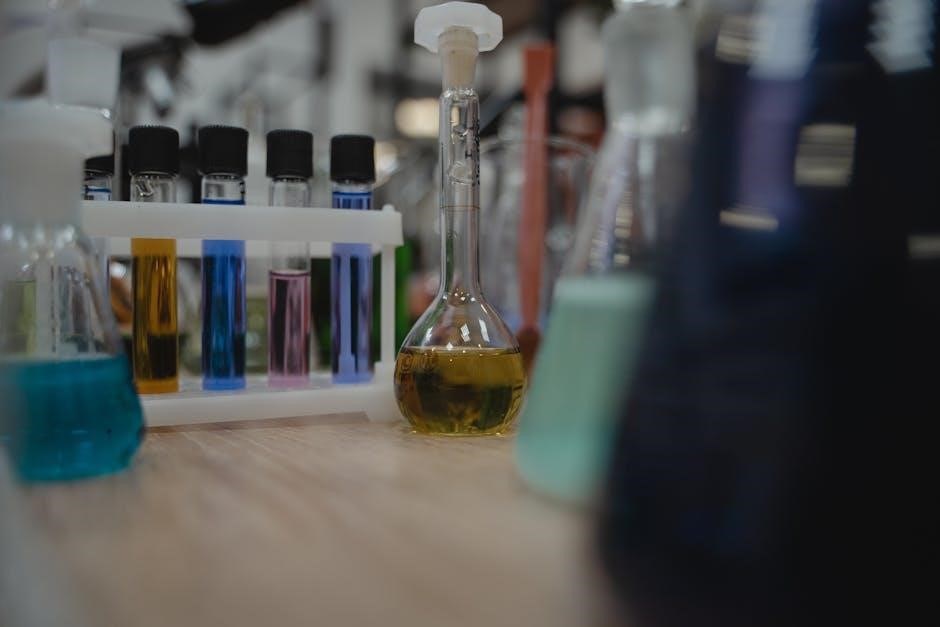
This section details qualitative analysis of ions, preparation of inorganic compounds, and reactions involving acids and bases, as outlined in lab manuals․
Qualitative Analysis of Ions
Qualitative analysis focuses on identifying ions present in a sample, utilizing characteristic reactions to confirm their existence․ Lab manuals detail procedures for detecting common cations and anions through precipitation, color changes, and gas evolution; These experiments involve systematic testing with reagents, observing resulting phenomena, and drawing conclusions based on established chemical principles․
Careful observation and accurate recording of results are crucial for successful identification․ Students learn to differentiate between ions based on their unique behaviors, building a foundational understanding of inorganic chemistry and analytical techniques․
Preparation of Inorganic Compounds
This section details the synthesis of various inorganic compounds through controlled chemical reactions․ Lab manuals provide step-by-step instructions for preparing salts, complexes, and other inorganic materials, emphasizing precise measurements and reaction conditions; Students learn techniques like precipitation, neutralization, and crystallization to obtain pure products․
Safety precautions are paramount when handling chemicals․ Proper disposal methods and understanding stoichiometry are essential for successful preparation and a thorough grasp of inorganic chemical principles․
Reactions of Acids and Bases
This part of the lab manual explores fundamental acid-base reactions, including neutralization, salt formation, and pH determination․ Experiments demonstrate the properties of strong and weak acids/bases, utilizing indicators and titration techniques for accurate analysis․ Students will observe reactions between acids and metals, carbonates, and bases․
Understanding these reactions is crucial for comprehending chemical equilibrium and quantitative analysis, with safety protocols emphasized throughout each procedure․
Organic Chemistry Experiments
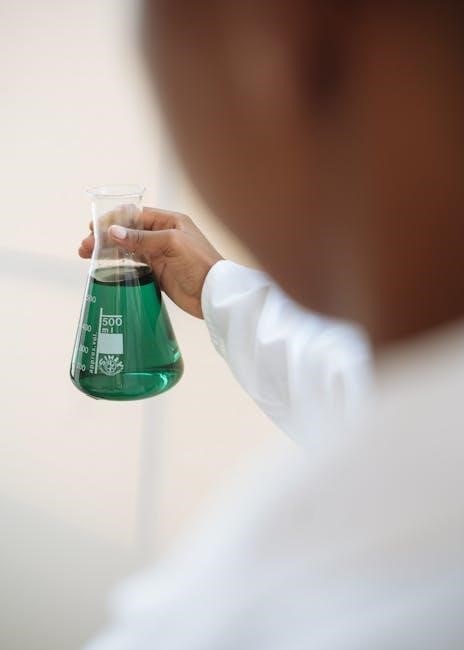
This section focuses on distillation, purification, and identifying functional groups within organic compounds, mirroring research lab procedures for practical skill development․
Distillation and Purification of Organic Compounds
Distillation is a crucial technique for separating liquid mixtures based on boiling points, a cornerstone of organic chemistry․ This experiment details fractional distillation, a refined method for achieving higher purity․ Students will learn to assemble distillation apparatus correctly, controlling heating rates for optimal separation․
Purification techniques, like recrystallization, are also explored, removing impurities and obtaining a pure product․ Careful observation of melting points confirms successful purification․ The manual emphasizes safety precautions when handling volatile organic compounds and utilizing heating equipment, ensuring a secure learning environment․
Identification of Functional Groups
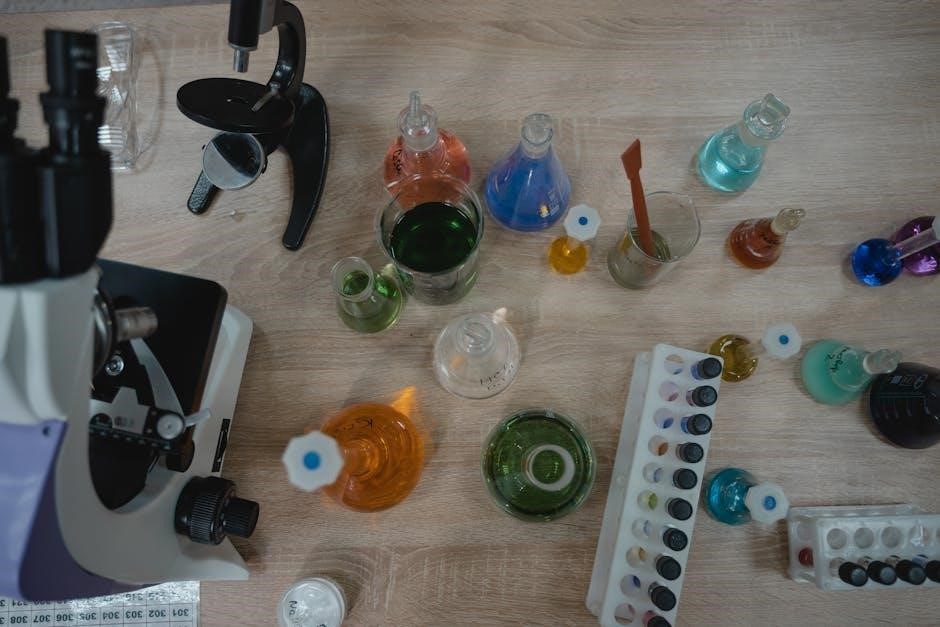
This section focuses on recognizing key functional groups – the reactive parts of organic molecules – through characteristic tests․ Students will perform qualitative analyses, utilizing reagents to observe specific reactions indicating the presence of alcohols, aldehydes, ketones, and carboxylic acids․
Detailed procedures guide observation of color changes, precipitate formation, or gas evolution, linking these phenomena to specific functional groups․ Safety protocols for handling potentially hazardous chemicals are paramount, alongside accurate record-keeping of experimental observations for reliable identification․
Basic Organic Reactions
This part of the manual introduces fundamental organic reaction types, like substitution, addition, and elimination, using simple, illustrative examples․ Students will execute reactions, carefully monitoring changes and isolating products to understand reaction mechanisms․
Emphasis is placed on proper technique, reagent handling, and safety precautions․ Detailed instructions guide the process, fostering a practical understanding of how molecular structures transform during chemical reactions, building a foundation for advanced organic chemistry concepts․
Quantitative Analysis
This section details methods like gravimetric and volumetric analysis, enabling precise determination of substance quantities through careful measurement and calculation․
Gravimetric Analysis
Gravimetric analysis is a quantitative method determining a substance’s amount by measuring the mass of a related compound․ This technique relies on converting the analyte into an insoluble precipitate, carefully filtering, washing, and then accurately weighing the dried precipitate․ Precise measurements are crucial for accurate results, demanding meticulous technique and calibrated equipment․
The process involves stoichiometric calculations to relate the precipitate’s mass back to the original analyte’s quantity․ Common applications include determining chloride content or analyzing mineral compositions, offering a highly accurate, albeit time-consuming, analytical approach․
Volumetric Analysis
Volumetric analysis, also known as titration, determines a substance’s concentration by reacting it with a solution of known concentration (the titrant)․ This quantitative technique relies on observing the reaction’s endpoint, often using indicators that change color or monitoring pH changes․ Accurate volume measurements using burettes and pipettes are paramount for precise results․
Titrations are widely used for acid-base, redox, and complexometric analyses, providing a relatively rapid and accurate method for determining unknown concentrations in various chemical applications․
Data Analysis and Reporting
Effective lab reports require meticulous recording of observations, thorough error analysis, and clear presentation of findings, ensuring scientific rigor and reproducibility․
Recording Observations
Detailed and accurate observation recording is paramount in any chemistry experiment․ This involves noting both qualitative and quantitative data meticulously․ Qualitative observations encompass descriptions of color changes, precipitate formation, or gas evolution – details perceived through the senses․ Quantitative data includes precise measurements obtained using calibrated instruments like graduated cylinders and balances․
Record all data immediately in a lab notebook, avoiding reliance on memory․ Include units with every numerical value․ Observations should be objective and free from personal interpretation․ Any deviations from the expected procedure or unusual occurrences must also be documented promptly․ Proper recording ensures data integrity and facilitates accurate analysis later․
Error Analysis
Comprehensive error analysis is crucial for evaluating experimental results․ Identify potential sources of error, categorizing them as systematic or random․ Systematic errors consistently skew results in one direction, often due to faulty equipment or procedural flaws․ Random errors, conversely, fluctuate unpredictably․
Quantify errors whenever possible, calculating percent error to compare experimental values with theoretical ones․ Discuss how these errors might have impacted the results and suggest improvements to minimize them in future experiments․ A thorough error analysis demonstrates critical thinking and scientific rigor․
Writing a Lab Report
A well-structured lab report clearly communicates your experimental process and findings․ Begin with an introduction outlining the experiment’s purpose and relevant theory․ Detail the procedures followed, including materials used and specific techniques employed․ Present your observations and data in organized tables and graphs․
Follow with a discussion interpreting your results, addressing any discrepancies, and performing error analysis․ Conclude by summarizing key findings and their significance․ Ensure clarity, conciseness, and proper scientific formatting throughout the report․
Advanced Experiments (Class 12 Level)
Class 12 experiments delve into electrochemical cells and chemical kinetics, mirroring research lab procedures for a deeper understanding of complex chemical principles․
Electrochemical Cells
Exploring electrochemical cells involves constructing and analyzing various cell types, like Daniell cells, to understand redox reactions and their practical applications․ Students will measure cell potentials under differing conditions, investigating factors influencing these values․
This includes varying concentrations of electrolytes and temperatures, applying the Nernst equation for calculations․ The lab emphasizes understanding cell notation, electrode potentials, and the relationship between Gibbs free energy and cell potential․ Practical skills in assembling cells and accurate potential measurements are crucial, alongside data analysis and report writing․
Chemical Kinetics
Investigating chemical kinetics focuses on determining reaction rates and the influence of factors like concentration, temperature, and catalysts․ Experiments typically involve monitoring reactant disappearance or product formation over time, utilizing methods like spectrophotometry or titration․
Students will analyze initial rates, determine rate laws, and calculate activation energies․ Understanding Arrhenius equation and collision theory is vital․ The lab emphasizes precise timing, accurate measurements, and graphical analysis of kinetic data, culminating in a comprehensive lab report detailing findings and conclusions․
Resources and References
Essential resources include the NCERT Chemistry Lab Manual and Zubrick’s Organic Chemistry Lab Survival Manual, providing comprehensive guidance for experiments and techniques․
NCERT Chemistry Lab Manual
The NCERT Chemistry Lab Manual serves as a foundational resource for students undertaking practical chemistry studies, particularly within the CBSE framework․ Direct download links are readily available for the latest editions, ensuring access to current experimental procedures and safety guidelines․
This manual meticulously outlines experiments for both Class 11 and Class 12, aligning with the prescribed syllabus; It’s designed to foster a deep understanding of chemical principles through hands-on application, promoting analytical skills and accurate observation techniques․ Students should utilize this manual alongside their textbook for optimal learning․
Organic Chemistry Lab Survival Manual (Zubrick)
Zubrick’s Organic Chemistry Lab Survival Manual is a highly regarded companion for students navigating the complexities of organic chemistry experiments․ This comprehensive resource, containing 347 pages, offers detailed guidance on techniques, safety protocols, and troubleshooting common issues encountered in the lab․
It’s recognized for its practical approach and clear explanations, making it an invaluable tool for both beginners and experienced students․ The manual aids in understanding experimental procedures and interpreting results effectively, enhancing overall laboratory performance and comprehension․